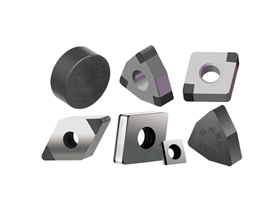
Cutting parameters for cubic boron nitride (PCBN) inserts refer to a set of key process variables set to control the machining process when using PCBN inserts. These parameters directly determine machining efficiency, tool life, and workpiece quality, serving as the "operating system" of the entire cutting process.
Cutting parameters include cutting speed (Vc), feed rate (f), and depth of cut (ap). The core of efficient PCBN insert machining lies in the dynamic balance among these three elements.

I. First, Understand the Specificity of PCBN Inserts
Although cutting parameters can be referenced from one another, a key question must first be clarified: What makes cubic boron nitride different from other tool materials?
·Hot hardness advantage: Its hardness at 1200°C is still higher than that of carbide at room temperature, meaning it is highly suitable for continuous cutting at high temperatures. What PCBN inserts fear is not high temperature, but severe thermal cycling, such as thermal shock during interrupted cutting.
·High elastic modulus: The cutting edge is extremely hard, with almost no deformation buffer, making it highly sensitive to micro entry, micro movements, and vibrations.
·Chemical inertness: It hardly diffuses or dissolves with ferrous metals at high temperatures, making it more suitable for machining difficult-to-cut materials such as cast iron and hardened steel. However, for adhesive materials (e.g., mild steel, stainless steel), it tends to cause built-up edge.
Therefore, the cutting parameters for PCBN inserts are not an "improvement" from those of carbide inserts, but rather a different set of determination logic: taking high linear speed as the core while strictly controlling the thermo-mechanical impact during entry and exit.
II. Logic for Selecting the Three Cutting Elements for PCBN Inserts
1) Cutting speed (Vc): Determines efficiency and thermal mechanism. The advantage of PCBN inserts lies in maintaining hardness at high temperatures. Therefore, within a reasonable range, the higher the speed, the higher the cutting temperature, and the more stable the tool.
2) Feed rate (f): Determines tool load and surface quality. Feed rate directly affects cutting force, surface roughness, and cutting edge load. The upper limit of feed rate allowed for PCBN inserts is usually higher than that for carbide inserts, but the limiting factors are often machine tool power and clamping rigidity.
3) Depth of cut (ap): Determines stability and efficiency. When the depth of cut exceeds 1.5 mm, cutting force increases non-linearly. PCBN inserts allow large depths of cut, but this requires high machine rigidity, tool clamping without overhang, and a large corner radius.
III. Recommended Parameter Selection for Different Materials
For different workpiece materials, the recommended cutting parameters when using PCBN inserts also vary.
For hardened steel (HRC55-65): Thermal stability dominates; avoid interrupted impact. Recommended parameters: Vc: 120–200 m/min, f: 0.08–0.2 mm/r, ap: 0.1–0.3 mm.
For gray cast iron / ductile cast iron: Speed can be significantly increased to achieve efficiency advantages. Recommended parameters: Vc: 300–800 m/min, f: 0.1–0.3 mm/r, ap: 0.5–2 mm.
Remember, the best cutting parameters are not those with the largest numbers, but those with the most reasonable system compatibility. The machine tool, workpiece, and tool form a system; only when they match each other can the value of PCBN inserts be truly realized.