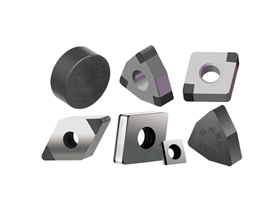
In the field of high-hardness material machining, PCBN (Polycrystalline Cubic Boron Nitride) inserts are widely used for turning operations on hardened steel, gray cast iron, and alloy cast iron due to their excellent hardness, wear resistance, and high-temperature stability. However, in practical applications, many enterprises encounter issues such as significantly reduced tool life, abnormal wear, and even sudden failure.
From an engineering practice perspective, abnormal wear of PCBN inserts is typically not caused by a single factor but results from the combined effects of multiple aspects, including material compatibility, cutting parameters, tool geometry, and the machining system. Therefore, a systematic analysis of abnormal wear is of great significance for improving machining stability and reducing overall costs.
Before analyzing the causes of abnormal wear, it is necessary to classify the typical wear patterns of PCBN inserts. Different wear morphologies often correspond to different failure mechanisms.
I. Common Wear Forms of PCBN Inserts
· Flank wear. Flank wear is the most common and relatively normal type of wear, characterized by the gradual formation of a uniform wear land on the area where the insert flank contacts the workpiece. Under reasonable working conditions, this type of wear is predictable and serves as an important basis for assessing insert life.
· Edge chipping and fracturing. Edge chipping typically manifests as local breakage on the tool tip or cutting edge. In severe cases, fracturing of the insert edge may occur. This type of wear is often sudden failure and significantly impacts machining stability.
· Thermal wear and burning. Under high-temperature conditions, phenomena such as oxidation and discoloration (blackening or bluing) may appear on the insert surface, accompanied by a marked acceleration of the wear rate. This type of wear is usually related to inadequate control of cutting heat.
· Adhesive wear. When machining materials with certain plasticity, workpiece material tends to adhere to the insert surface, forming a built-up edge or adhesion layer, which subsequently affects the machined surface quality and accelerates insert wear.
II. Main Causes of Abnormal Wear of PCBN Inserts
Based on practical machining experience, abnormal wear of PCBN inserts can be mainly attributed to the following four aspects.
· Mismatch between tool material and workpiece material. The performance of PCBN inserts varies significantly depending on CBN content and binder type. For example, using a tool material grade suitable for gray cast iron on hardened steel will result in rapid wear failure of the insert. Therefore, material matching is the primary factor determining insert life.
· Unreasonable cutting parameter settings. Cutting parameters have a direct impact on the wear behavior of PCBN inserts, with cutting speed being particularly critical. Excessively high cutting speed leads to a rapid increase in cutting temperature, aggravating thermal wear and diffusion wear of the tool. Conversely, excessively low cutting speed, while reducing temperature, may lead to unstable cutting and increase mechanical impact. Therefore, in practical applications, parameters should be systematically optimized based on material characteristics and machining requirements.
· Improper tool geometry design. Tool geometric parameters (such as nose radius and edge preparation form) directly influence stress distribution and thermal distribution during the cutting process. For example, an excessively small nose radius leads to stress concentration, increasing the risk of chipping. An overly sharp cutting edge reduces the tool's impact resistance.
· Insufficient machining system stability. The machining system includes factors such as machine tool rigidity, tool clamping method, and workpiece fixturing condition. These factors significantly affect the actual performance of PCBN inserts. When machine tool rigidity is insufficient or workpiece runout exists, periodic impact loads are generated during cutting, leading to insert chipping or abnormal wear.
For the problem of abnormal wear of PCBN inserts, a systematic analysis method is recommended, rather than simply replacing the insert or conducting repeated trials.
First, observe the wear morphology to make a preliminary judgment on the failure type. Second, based on the wear characteristics, analyze the corresponding dominant factor (material matching, parameter settings, or structural issues). Finally, conduct verification through single-variable adjustments to avoid interference caused by the superposition of multiple factors.