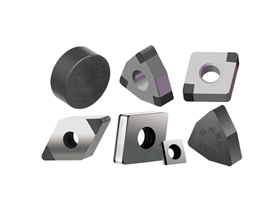
In the field of hard turning, the machining efficiency of PCBN inserts is far higher than that of traditional carbide tools. However, "chipping" is also one of the most frequently reported issues by users.
From a mechanical perspective, chipping of CBN inserts is essentially a failure behavior that occurs when local stress during cutting exceeds the tolerance limit of the PCBN material. In fact, most CBN insert chipping is not caused by a single factor, but is the result of a mismatch in the "tool–process–equipment–material" system.
Why do PCBN inserts experience corner breakage, cracking, fragmentation, or sudden failure? This article, from Bote Tools, systematically analyzes the mechanism of CBN insert chipping from multiple perspectives such as cutting parameters, machine rigidity, interrupted cutting, and material compatibility, and provides you with reasonable solutions.

1. Why do CBN inserts chip?
PCBN material has extremely high hardness and wear resistance, with strong resistance to abrasion and compression, but its toughness is lower than that of carbide.
Therefore, CBN inserts are more suitable for high-hardness material machining, stable cutting, and high-speed machining, and are not suitable for conditions such as insufficient machine rigidity, severe vibration, or strong impact.
Many chipping problems are essentially not "tool wear", but "impact failure".
2. Causes of CBN insert chipping
2.1 Unreasonable cutting parameters. In particular, fluctuations in feed rate, excessive depth of cut, and sudden entry/exit can cause a sudden increase in impact on the tool nose. In hard turning, if users continue using parameters intended for carbide inserts, CBN inserts often chip rapidly.
Solution: Reduce local cutting impact; stabilize feed; select a reasonable depth of cut; choose appropriate cutting parameters based on working conditions.
2.2 Excessive impact from interrupted cutting. This is a typical challenge in PCBN insert applications, such as keyways, oil holes, gear end faces, and intermittent cylindrical surfaces, all of which cause periodic impact on the tool.
Solution: Use high-toughness PCBN grades; employ a negative chamfer edge design; increase machine stability; avoid excessive overhang.
2.3 Insufficient rigidity of machine tool and tool holding. Many users overlook that CBN inserts require higher equipment rigidity than carbide inserts. Especially in hard turning, even slight vibration can generate high-frequency impact on the tool nose.
Solution: Shorten tool holder overhang; improve clamping rigidity; check spindle accuracy; reduce system vibration; use high-rigidity tool holders.
2.4 Improper edge preparation of the insert. The edge preparation of CBN inserts can be, to some extent, more important than the material itself. Features such as negative chamfer, edge honing, and rounding directly affect the stress distribution on the tool nose. The core function of a negative chamfer is to direct cutting forces more toward the interior of the tool body rather than concentrating them on a tiny area at the tool nose.
Solution: Select correct tool nose edge parameters; match parameters to working conditions.
2.5 Mismatch of PCBN material grade. Many chipping problems are essentially "material selection errors". For example, applying a CBN grade designed for continuous cutting to interrupted cutting conditions will often result in chipping of the CBN insert.
Solution: Match material to working conditions; select the appropriate CBN insert material grade based on the machining conditions.
3. How to determine whether CBN insert wear is "normal wear" or "abnormal chipping"?
Characteristics of normal wear: Uniform flank wear, gradual edge rounding, and stable tool life decline. This indicates that parameters are generally reasonable and the insert is undergoing normal wear.
Characteristics of abnormal chipping: Sudden notch on the tool nose, local fragmentation, highly unstable tool life, and large performance variation among inserts from the same batch. This indicates abnormal chipping of the CBN insert and requires inspection.
When abnormal chipping occurs on CBN inserts, it is usually necessary to: check machine vibration, check clamping, adjust parameters, change edge geometry, and optimize material grade selection.
Conclusion: Chipping of CBN inserts has never been a simple "tool problem". It is essentially the result of the combined action of tool material, tool geometry, cutting parameters, machine rigidity, workpiece condition, and machining conditions. To achieve effective application of CBN inserts, the approach is not to "force the tool to withstand harsh conditions", but to achieve systematic matching so that the tool always operates under stable conditions.