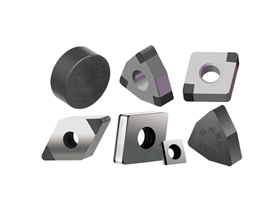
In the superhard tool industry, "what hardness is suitable for CBN inserts" is almost one of the most common questions users ask.
Many sources directly provide a seemingly standard answer: CBN inserts are suitable for machining high-hardness materials in the range of HRC 45-68.
This answer is not wrong in itself, but it is incomplete. Because material hardness is not the only factor determining whether CBN inserts can work stably.
Why are CBN inserts more suitable for machining high-hardness materials?
From a materials science perspective, the biggest characteristic of CBN (Cubic Boron Nitride) is not merely "hardness"; its true advantages lie in:
·High hot hardness retention;
·High chemical stability with ferrous materials;
·Much higher wear resistance than cemented carbide;
·Ability to maintain cutting edge stability under high-speed cutting.
Especially in the machining of hardened steel, the cutting zone temperature is often very high. Common cemented carbide is prone to softening, diffusion wear, plastic deformation, and edge collapse under high temperatures, whereas CBN can still maintain high hardness under high-temperature conditions. Therefore, it is particularly suitable for continuous cutting of high-hardness hardened materials, which is the core reason why "turning instead of grinding" can be achieved.
Why does the industry generally take HRC 45 as the dividing line for using CBN inserts?
This is because most steels exhibit significant organizational hardening characteristics above HRC 45. Examples include an increased martensite ratio, enhanced carbide strengthening, concentrated cutting heat, and accelerated wear of conventional tools. At this point, the tool life of cemented carbide often drops sharply, while PCBN begins to show its advantages. Thus, the industry has gradually formed the understanding that CBN inserts are suitable for machining materials with hardness above HRC.
Why are some high-hardness materials easier to machine than low-hardness materials?
Many users think that, theoretically, the higher the material hardness, the more difficult the machining should be.
However, the actual situation is: certain high-hardness materials with stable hardened microstructures can actually achieve more stable tool life than low-hardness materials. The reasons are that high-hardness materials often have more uniform microstructures, more stable cutting conditions, less plastic deformation, and lower adhesive wear; whereas some low-hardness materials may still have certain plasticity, making them prone to built-up edge, thermal cracking, and chipping.
Therefore, in many cases, what truly affects the life of CBN inserts is the structural stability of the material, not simply the HRC hardness number.
How do different CBN content levels affect the machinable hardness range?
PCBN is not a single material but a composite of CBN micro-powder and binder. Different grades vary significantly.
Generally, the industry classifies them into high-CBN-content grades and medium-to-low-CBN-content grades.
Typically, high-CBN-content grades (CBN content between 80% and 95%) are suitable for machining gray cast iron and high-hardness cast iron. Examples include Berlt CBN grades BTS2800, BTS3800, BTS2900, BTS3100, etc. Medium-to-low-CBN-content grades (CBN content between 55% and 65%) are suitable for machining hardened steel. Examples include Berlt CBN grades BTS6000, BTS6000A, BTS6500, etc.
Typical application ranges of CBN inserts for different hardness levels
Below HRC 45: CBN inserts are generally not recommended. The material is too ductile, has a strong tendency to adhere to the tool, and the cost advantage is low. In most cases, cemented carbide tools are more economical.
HRC 45-55: This is the range where CBN inserts begin to establish an advantage. Common applications include finishing of quenched and tempered steel, medium-hardness die steel, and some heat-treated gears. Matching the correct grade is critical at this stage.
HRC 55-65: This is the most typical and mature application range for CBN inserts. It includes GCr15 bearing steel, Cr12MoV die steel, hardened gear steel, high-hardness rolls, and high-hardness shaft parts. It is also the most common range for "turning instead of grinding."
Above HRC 65: This belongs to the high-difficulty ultra-hard machining field. Here, higher requirements are placed on tool quality, edge preparation, machine rigidity, and process stability. Only with comprehensive matching of multiple factors can stable use be ensured.
Final Remarks: The "hardness range for CBN inserts" may seem like a simple parameter question, but behind it lies the entire embodiment of high-hardness cutting applications. Only by matching all parameters with each other can the application effect of CBN inserts be maximized.