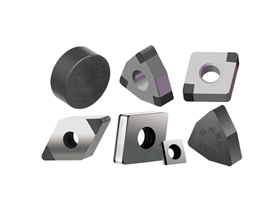
In modern machining applications, PCBN (polycrystalline cubic boron nitride) cutting tools, with their high hardness, excellent wear resistance, and superior high-temperature stability, have become essential tools for machining cast iron, hardened steel, and other high-hardness materials. However, in real production environments, tool chipping (edge breakage) remains a frequent problem, which not only affects machining quality and process stability, but also significantly increases production costs and downtime risks.
From a field application perspective, PCBN tool chipping is not caused by a single factor, but rather by the superposition and coupling of multiple factors, including cutting parameter matching, clamping system stability, workpiece material structural characteristics, intrinsic tool quality, and cooling/lubrication conditions. Therefore, solving chipping problems must adopt a systematic approach, rather than relying on single-point optimization.
I. Imbalance in Cutting Parameter Matching
At the cutting parameter level, excessively high cutting speed causes the tool tip region to experience intense thermal loads in a very short time, generating significant thermal shock stress. Excessive feed rate leads to a sharp increase in unit-edge load, placing the cutting edge in a state of high stress concentration. Improper selection of depth of cut also results in abnormal cutting force distribution.
Under such operating conditions, the superposition of thermal loads and mechanical loads can easily exceed the structural load-bearing limits of PCBN materials, thereby inducing chipping failure. Therefore, it is essential to systematically match cutting parameters according to the characteristics of the workpiece material and the structural features of the tool, optimize parameters under different working conditions, and establish a stable and reliable parameter system through trial cutting, validation, and accumulation of empirical data.
II. Insufficient Stability of the Clamping System
At the level of clamping and machine tool systems, insufficient tool holding rigidity or unstable clamping force easily generates micro-vibrations during cutting. Misalignment between the tool and the spindle (coaxiality deviation) leads to uneven load distribution, while insufficient overall machine rigidity may cause the system to enter resonance cutting zones.
For PCBN materials with high hardness and brittleness, such micro-vibrations rapidly evolve into micro-crack initiation sources at the cutting edge, gradually expanding into micro-chipping and ultimately developing into macroscopic chipping failure. Therefore, a stable clamping system, high coaxial accuracy, and high structural rigidity are fundamental conditions for ensuring stable PCBN cutting performance.
III. Non-Uniform Workpiece Material Structure
At the workpiece material level, the presence of hard inclusions, inhomogeneous microstructural regions, or localized hard-spot enrichment structures causes sudden changes in cutting resistance during machining, generating impact-type load inputs. Such discontinuous loads impose severe impact stress on the cutting edge structure, making it highly susceptible to instantaneous brittle fracture and chipping.
IV. Structural Defects in the Tool Body
At the intrinsic tool quality level, if micro-scale edge defects, internal micro-cracks, insufficient sintering densification, or non-uniform grain distribution exist during manufacturing, the fracture toughness threshold of the material is directly reduced, causing the tool to enter the failure regime prematurely under normal service loads. Such problems are essentially material-level and structural-level quality issues, which must be addressed through source-process control and manufacturing consistency management.
V. Inadequate Cooling and Lubrication Systems
In terms of cooling and lubrication conditions, insufficient cooling efficiency prevents timely and effective heat removal, causing the tool tip region to remain in a long-term high-temperature state, gradually degrading material performance. Meanwhile, thermal fatigue cracks are prone to form under cyclic heating and cooling, eventually inducing chipping failure. Therefore, proper selection of cooling media, stable supply systems, and scientifically designed cooling methods are key elements for ensuring the thermal stability of PCBN tools.
Long-term field machining experience shows that macroscopic chipping of PCBN tools essentially originates from microscopic failure paths: microstructural defects first form micro-crack initiation sources, which gradually propagate into micro-chipping under alternating mechanical loads and thermal stresses, and ultimately evolve into macroscopic structural failure.
Zhengzhou Berlt starts from the source of CBN materials to build a systematic quality control system. Through material structural design, sintering process stability control, crystal structure uniformity management, cutting-edge micro-surface quality engineering, and full-process manufacturing consistency control, a complete high-end tool quality assurance pathway is formed, achieving a systematic upgrade from “material-level control” to “engineering-level stability.”